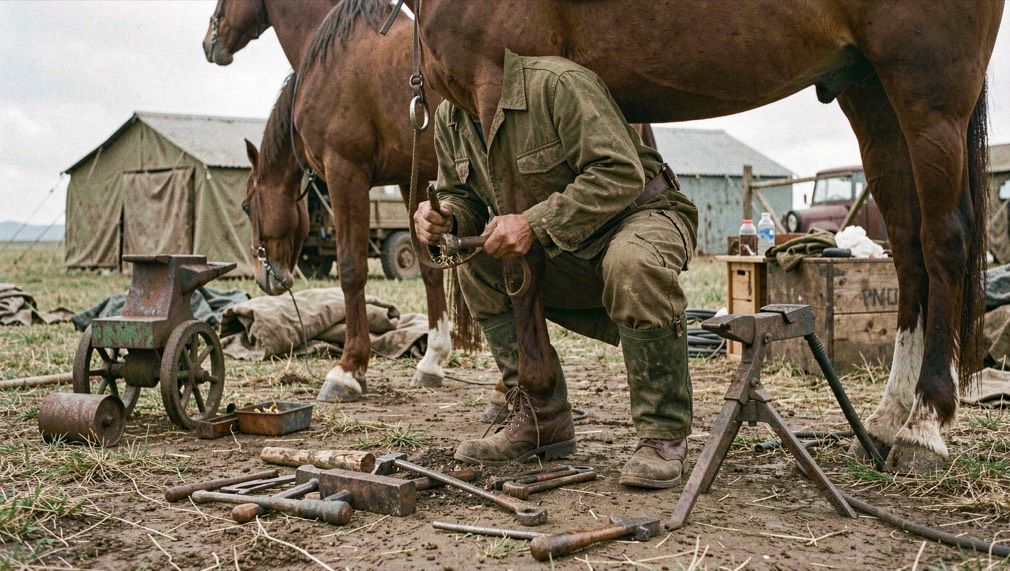
Ironwork begins with heat and hammering. A smith heats a bar until it glows, then moves the metal with hammer and anvil while it is soft, and the same three actions, drawing out, upsetting and bending, sit behind almost every historic iron fitting that survives. The technique is old, but the vocabulary is precise, and a beginner can learn most of it from a good bench reference such as the forge and ironwork notes kept by working smiths.
What does a blacksmith actually do to the metal?
A blacksmith changes the shape of iron or steel while it is hot. The main operations are drawing out, which lengthens a bar and reduces its section; upsetting, which shortens and thickens it; bending, which curves it; punching, which makes a hole without drilling; and forge welding, which joins two pieces by hammering them together at welding heat. Each operation has a temperature range, judged by colour rather than by a gauge, and each leaves a signature in the finished surface.
Drawing out is done over the horn or the far edge of the anvil, with the hammer striking in overlapping blows. Upsetting is done with the work held vertically and struck on the end, or by driving it against the anvil step. Bending is done over the horn for curves and in the vise for tight corners. Punching uses a tapered punch driven most of the way through from one side, then finished from the other, which leaves a slightly waisted hole rather than a clean cylinder.
Forge welding is the operation that most clearly separates forge work from other metal trades. The two surfaces are brought to a white heat, fluxed to keep out scale, and hammered together. A successful weld shows a faint line, not a gap, and it can be tested by bending the joint. Steel with higher carbon content is harder to weld and easier to burn, so the smith works at a lower heat and watches the colour closely.
Heat treatment applies mainly to carbon steel rather than to wrought iron. Annealing softens the steel by heating it and cooling it slowly. Hardening, or quenching, heats it and cools it quickly in oil or water. Tempering reheats the hardened piece to a lower temperature to trade some hardness for toughness. The colours that run across the polished surface during tempering, straw, brown, purple and blue, are the traditional guide to the temperature reached.
How is a coal or coke fire built and kept?
A forge fire is built in a hearth, usually a shallow cast iron pan set into a bench or a brick surround, with a tuyere or air pipe entering from below or the side. The fuel is coal, coke or gas. Coal is cheap and gives a reducing fire that suits welding, but it makes clinker and smoke. Coke burns cleaner and is easier to control. Gas forges give a steady, scale-free heat and are common in small workshops where smoke would be a nuisance.
The fire is started with paper, kindling and a little coal, and air is added gradually with a hand crank, a bellows or an electric blower. The smith builds the fire into a mound with the work buried near the tuyere, and keeps a wet patch at the edge to control the size of the hot zone. A fire that is too deep wastes fuel and burns the work; a fire that is too shallow cannot reach welding heat.
Clinker, the glassy residue that forms from impurities in coal, is raked out as it appears, because it blocks the air and insulates the fire. The fire is kept damped when not in use and rebuilt when it hollows out. Most of the skill in forge work is really fire management, since the hammer only does what the heat allows.
What tools does a beginner need at the anvil?
An anvil is the first purchase, and its anatomy matters more than its weight. The face is the flat working surface, the horn is the rounded end for curves, the step or cutting table is the soft block near the horn, the hardy hole takes bottom tools, and the Pritchel hole takes a punch. A good anvil rings when struck and rebounds the hammer; a dead anvil absorbs the blow and tires the smith.
Tongs are the second purchase, and they must fit the stock rather than the hand. A smith needs at least one pair sized to the bar being worked, with jaws that grip on the flat or the corner as required. Tongs that are too large let the work rotate; tongs that are too small cannot hold it at all. The reins should be long enough to keep the hand away from the fire but short enough to control the work.
Hammers are chosen by weight and face shape. A cross peen is the general purpose hammer for drawing out, a straight peen for long shapes, and a ball peen for riveting and texturing. A wire brush, a hot cut hardy, a cold chisel, a punch and a file complete the basic kit. A vise, a bench and a quench bucket are assumed.
Where can historic ironwork still be seen?
Historic ironwork survives in buildings, bridges and machines, and it can be read in the same way as a document. Wrought iron was made by refining pig iron in a finery or a puddling furnace, then worked under a hammer or a rolling mill. It is fibrous, welds well and resists corrosion better than mild steel, which is why so much nineteenth century structural iron is wrought rather than steel.
Cast iron was poured into moulds and is strong in compression but brittle in tension. It appears in columns, railings, lamp posts, fire escapes and architectural fronts. The line between the two is visible in the surface: wrought iron shows a grain and can be bent cold, cast iron shows a mould seam and breaks rather than bends.
In the United States, the industrial heritage of the Hudson and Mohawk valleys is unusually dense. The Burden Iron Works in Troy made horseshoes and railroad iron. The Watervliet Arsenal has a cast iron building from the mid nineteenth century. The ironclad Monitor was built at Rensselaer, and its armour plate and fittings are part of the same ironworking tradition. The Paley grilles at the New York State Capitol and the Ross Valve foundry in Troy show decorative and industrial casting side by side. A visitor can trace the whole sequence, ore, furnace, forge, foundry and finished fitting, within a short drive.
How can you tell wrought iron from cast iron?
A few simple tests separate the two. Wrought iron is soft enough to be cut with a chisel and bends without breaking; cast iron is hard and snaps. A fresh break in cast iron is grey and granular, while wrought iron shows a silky, fibrous fracture. Wrought iron rusts in layers that flake away slowly, and it can be forge welded; cast iron cannot be welded at the forge and is repaired by brazing or by bolting.
A magnet is not a reliable test, since both are magnetic. A spark test on a grinding wheel is more useful: wrought iron gives long, dull sparks, cast iron short, red sparks, and carbon steel bright, forked sparks. For anything of value, the safest approach is to look for a maker's mark, a foundry name or a date, and to record it before any cleaning.
Reading the iron in front of you
The ironwork that survives in a town is a record of what the local furnaces and forges could produce, and of what the people who paid for it wanted to see. A railing, a hinge, a bridge tie or a machine frame each carries the marks of its making: the taper of a drawn bar, the seam of a mould, the punch hole that was opened rather than drilled. Looking closely at those marks is a way of reading the industrial past without a library, and it costs nothing but attention. The next time you pass a cast iron column or an old gate, stop and look at the surface. The story of the forge is usually still there, in the grain of the metal and the shape of the joint.